If your dining table won’t open when you try to extend it, don’t force it. A stuck extension table is usually caused by something that can be identified and corrected, such as dirt or debris in the slides, a misaligned mechanism, dry or damaged extension rails, a loose screw, or a problem with the table leaf.
Fortunately, many dining table extension problems can be diagnosed and repaired at home using basic tools. The key is to identify what is preventing the table from moving before applying excessive force.
In this guide, you’ll learn how to fix a dining table that won’t open, how to inspect the extension slides, how to deal with a stuck dining table mechanism, and when it makes more sense to replace the hardware or call a furniture repair professional.
Related guide: If you want a broader guide covering different types of extension mechanisms and more repair situations, see our Dining Table Extension Mechanism Repair: DIY Guide.
Why Won’t My Dining Table Open?
An extendable dining table depends on sliding rails, runners, gears, hinges, locks, or other hardware to allow the tabletop to separate smoothly. When one of these components becomes dirty, misaligned, damaged, or obstructed, the table may become difficult or impossible to open.
Some of the most common causes include:
- Dust, crumbs, or debris inside the extension slides
- Dry or dirty metal rails
- Misaligned extension slides
- Loose screws or mounting hardware
- A damaged or bent extension rail
- A stuck locking mechanism
- Wood swelling caused by humidity
- A warped or improperly positioned table leaf
- Damaged gears or internal components
- The table being pulled from one side unevenly
Before attempting a repair, check whether your table has a separate removable leaf, a butterfly leaf, or a built-in extension mechanism. Different designs require slightly different approaches.
Step 1: Remove Everything From the Table
Start by clearing the dining table completely. Remove plates, decorations, table runners, centerpieces, and anything else sitting on the tabletop.
This may sound obvious, but a clear workspace makes it easier to inspect the table and prevents objects from falling when the table suddenly moves.
If the table is against a wall or surrounded by chairs, move it into an area where you have enough space to work around both ends. You should be able to pull the tabletop apart without hitting a wall, chair, cabinet, or other furniture.
Step 2: Check for a Lock or Latch
Some extendable dining tables have locking mechanisms underneath the tabletop. These locks prevent the table from accidentally separating during normal use.
Before pulling harder on the table, inspect the underside and edges for:
- Sliding locks
- Metal latches
- Knobs or levers
- Turn buttons
- Spring-loaded catches
- Small locking brackets
Make sure the locks are completely released before trying to open the table.
If the lock appears jammed, avoid using excessive force. A damaged latch can make the problem worse and may require replacement.
Step 3: Try Opening the Table Evenly
One of the easiest mistakes to make with an extendable dining table is pulling only one side.
Depending on the design, the extension slides may be synchronized. Pulling unevenly can cause the rails to bind or become slightly misaligned.
Place both hands near the ends of the table and apply steady, even pressure. If another person is available, have them pull the opposite side at the same time.
Do not jerk the tabletop or use sudden force. If it doesn’t move with reasonable pressure, stop and inspect the mechanism.
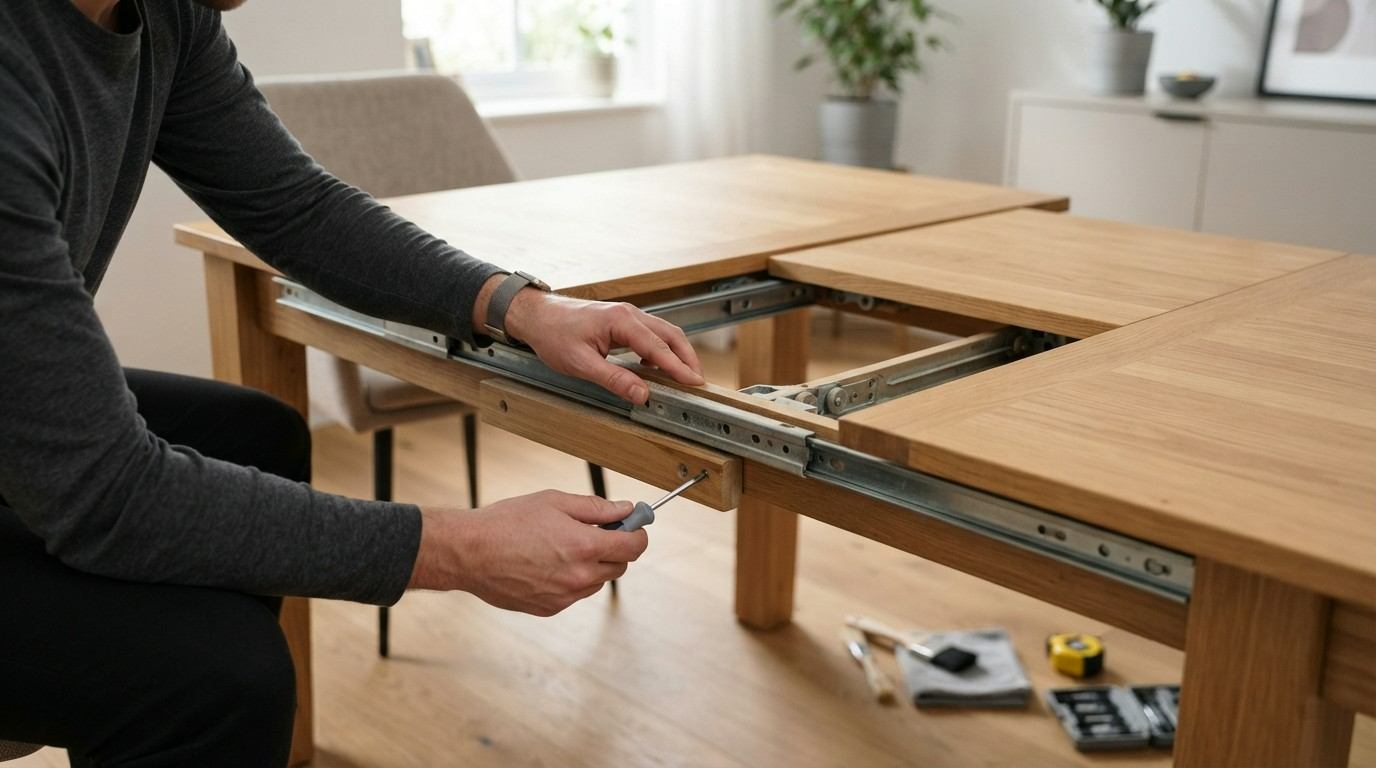
Step 4: Inspect the Dining Table Extension Slides
If the table still won’t open, the next step is to inspect the extension slides.
Look underneath the table for metal rails, wooden runners, brackets, rollers, or telescoping components. Check whether both sides appear to be positioned evenly.
Look for obvious problems such as:
- A rail that has moved out of position
- A loose mounting screw
- A bent metal bracket
- A screw head blocking the sliding mechanism
- Wood rubbing against the metal hardware
- Broken plastic or metal components
- Heavy dust or debris inside the track
If you find a loose screw, tighten it carefully. However, don’t overtighten screws into wood because this can strip the hole and create another repair problem.
Step 5: Clean the Extension Mechanism
Dust and small debris can accumulate inside dining table extension tracks over time. Food crumbs, pet hair, dirt, and wood particles can interfere with the movement of the slides.
Use a vacuum cleaner with a narrow attachment to remove loose debris. You can also use a soft brush to clean areas that are difficult to reach.
For stubborn dirt, wipe accessible metal surfaces with a clean, slightly damp cloth and allow them to dry completely before testing the mechanism.
Avoid flooding the mechanism with water or household cleaning products. Excess moisture can cause corrosion on metal hardware and may contribute to swelling or damage to wooden components.
Step 6: Check for Misalignment
Misalignment is another common reason an extendable dining table won’t open.
Stand in front of the table and look at the gaps between the tabletop sections. If one side appears higher, lower, farther forward, or closer together than the other, the extension mechanism may not be properly aligned.
Inspect the rails underneath the table to determine whether one slide has shifted.
If the mechanism uses adjustable mounting screws, carefully loosen them just enough to reposition the hardware. Align both sides and then retighten the screws.
After making a small adjustment, test the table again. Avoid making several adjustments at once because it can make it difficult to determine what actually fixed the problem.
Step 7: Check the Table Leaf
If your dining table uses a removable extension leaf, check the leaf before forcing the tabletop apart.
The leaf may be incorrectly positioned, stored improperly, or slightly swollen due to changes in humidity. Even a small dimensional change can make it difficult for the table sections to separate or for the leaf to fit correctly.
Check the leaf for:
- Warping
- Swollen edges
- Damaged alignment pins
- Broken hinges
- Loose hardware
- Objects trapped underneath or between components
If the leaf is already installed and appears stuck, don’t pry it out with excessive force. Inspect the hinges, locks, and surrounding rails first.
How to Fix a Dining Table That Is Stuck Halfway
A dining table that opens a few inches and then stops usually indicates a specific obstruction or alignment problem.
First, stop pulling and look underneath the table. Check whether one of the rails is reaching the end of its travel or whether something is physically blocking it.
If you can safely access the mechanism, slowly move the tabletop back toward the closed position. Then inspect the rails again.
Clean the tracks and check for loose screws, bent brackets, or objects caught inside the mechanism.
If the table repeatedly stops at exactly the same point, pay particular attention to that location. A damaged section of the rail, a bent component, or an obstruction is more likely than a general lubrication issue.
Should You Lubricate Dining Table Extension Slides?
Lubrication may help if the extension mechanism is dry and operating with excessive friction, but it should not be the first solution for every stuck table.
First clean the mechanism and identify the type of hardware being used. Some manufacturers specify a particular lubricant or maintenance procedure.
If lubrication is appropriate, use a small amount of a lubricant compatible with the mechanism and apply it sparingly to the appropriate sliding surfaces.
Do not saturate the rails. Excess lubricant can attract dust and debris, potentially creating another problem later.
Important: If the mechanism is bent, broken, severely misaligned, or physically damaged, lubricant will not repair it. The damaged component may need adjustment or replacement.
What If the Dining Table Still Won’t Open?
If you’ve cleaned the tracks, checked the locks, inspected the leaf, and corrected obvious alignment problems but the table still won’t open, the extension hardware may be damaged.
Look for:
- Bent metal extension slides
- Broken rollers
- Damaged gears
- Cracked mounting brackets
- Stripped screw holes
- Broken synchronization components
- Damaged hinges
At this stage, take photographs of the mechanism and identify the manufacturer and table model if possible. Replacement dining table slides and extension hardware are available in different lengths and configurations, so measuring the existing hardware before purchasing replacement parts is important.
Need more repair ideas? Our main Dining Table Extension Mechanism Repair: DIY Guide covers additional problems including uneven extensions, leaves that don’t fit, noisy mechanisms, lubrication, maintenance, and when to replace the extension mechanism.
When Should You Replace the Dining Table Extension Mechanism?
Cleaning and adjustment can solve many minor problems, but some mechanisms eventually wear out.
Consider replacement when the extension slides are bent, badly worn, cracked, repeatedly coming loose, or no longer move smoothly after cleaning and adjustment.
Replacement may also make sense when the existing hardware has damaged rollers or internal components that are no longer functioning correctly.
Before ordering replacement hardware, measure the existing slides carefully. Record the length, mounting position, extension length, screw-hole locations, and overall configuration.
Buying the wrong size can create additional alignment problems and may prevent the table from opening or closing correctly.
Common Mistakes to Avoid
When trying to repair a stuck dining table, avoid these common mistakes:
- Forcing the tabletop apart: Excessive force can bend rails or damage wooden joints.
- Using excessive lubricant: Too much lubricant can attract dirt and debris.
- Ignoring loose screws: Loose hardware can cause the slides to become misaligned.
- Using the wrong replacement hardware: Extension slides are available in different sizes and designs.
- Ignoring a damaged mechanism: A bent or broken component generally needs repair or replacement rather than more lubrication.
- Working without enough space: Make sure the table can move safely before testing the extension.
Quick Troubleshooting Guide
| Problem | Possible Cause | What to Try |
|---|---|---|
| Table won’t move at all | Lock engaged or mechanism jammed | Check locks and inspect the underside |
| Table opens only a little | Obstruction or damaged slide | Clean the rails and inspect the stopping point |
| One side moves more than the other | Misalignment | Inspect and realign the extension slides |
| Table feels very stiff | Dirty or dry mechanism | Clean and lubricate if appropriate |
| Table makes grinding sounds | Debris or damaged hardware | Stop and inspect the rails |
| Leaf doesn’t fit | Misalignment, swelling, or damaged leaf | Check the leaf and extension mechanism |
| Mechanism repeatedly jams | Worn or damaged hardware | Consider adjustment or replacement |
When to Call a Furniture Repair Professional
Many simple problems can be handled as a DIY project, but professional furniture repair may be the better choice when the table is expensive, antique, heavily damaged, or constructed with a complicated mechanism.
You should also consider professional help if the tabletop is extremely heavy, the mechanism is difficult to access, or repairing it requires major disassembly.
For valuable solid-wood furniture, an incorrect repair can cause more damage than the original problem. A furniture repair specialist can determine whether the issue is with the extension hardware, the table frame, the wood itself, or a combination of problems.
How to Prevent Your Dining Table From Getting Stuck Again
Once you’ve successfully fixed the table, regular maintenance can reduce the chance of another problem.
- Keep extension rails free from dust and crumbs.
- Do not force the table when it becomes difficult to open.
- Open and close the table evenly.
- Check screws and mounting hardware periodically.
- Store removable leaves properly when they are not being used.
- Follow the manufacturer’s maintenance recommendations.
- Inspect the mechanism if you notice unusual clicking, grinding, or resistance.
The earlier you address a stiff or noisy extension mechanism, the less likely it is to develop into a more expensive repair.
Frequently Asked Questions
Why won’t my dining table open?
The most common causes include a locked mechanism, dirt or debris in the extension slides, misalignment, loose screws, damaged hardware, or a table leaf that is not positioned correctly.
Can I force open a stuck dining table?
No. Avoid excessive force. Pulling too hard can bend the extension rails, damage the table frame, strip screws, or break internal components. Inspect the mechanism first.
How do I fix a dining table that is stuck halfway?
Check the point where the table stops and inspect the extension rails for debris, damaged components, loose screws, or misalignment. Clean the mechanism and test it again before attempting further adjustments.
Can I use WD-40 on dining table extension slides?
Don’t automatically use WD-40 or another general-purpose product. The appropriate lubricant depends on the type of extension mechanism and the manufacturer’s recommendations. Cleaning and inspection should come first.
How do I know if my dining table slides need to be replaced?
Replacement may be necessary if the slides are bent, cracked, badly worn, repeatedly coming loose, or contain damaged rollers or internal components that cannot be repaired effectively.
Why is my extendable dining table uneven when I open it?
An uneven extension can be caused by misaligned slides, loose mounting hardware, an obstruction, or uneven pulling. Inspect both sides of the mechanism and make sure the extension rails are positioned correctly.
Can I repair a dining table extension mechanism myself?
Yes, many minor problems such as dirt, loose screws, simple alignment issues, and dry slides can be addressed as DIY repairs. More complicated or structural damage may require professional furniture repair.
Keep Your Dining Table Working Smoothly
A dining table that won’t open can be frustrating, especially when you need the extra space for guests. Fortunately, the problem is often caused by something relatively simple such as a locked mechanism, debris, misalignment, or loose hardware.
Start with the simplest solutions: clear the table, release the locks, inspect the extension slides, clean the mechanism, and check for alignment problems. Avoid forcing the tabletop because excessive pressure can turn a minor problem into a costly repair.
If cleaning and basic adjustments don’t solve the problem, inspect the extension hardware for damage and determine whether the slides or other components need replacement.
For more detailed information about different dining table extension mechanisms and additional repair techniques, visit our Dining Table Extension Mechanism Repair: DIY Guide.
With regular cleaning, proper use, and early attention to small problems, an extendable dining table can continue opening and closing smoothly for years.