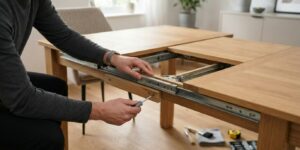
Why Your Dining Table Wobbles
A wobbly dining table might seem like a small issue, but over time it can become annoying and even dangerous—especially if drinks or hot dishes are involved. The good news? Most wobbles come from simple causes such as loose screws, uneven floors, or worn-out joints. Before you think about buying a new table, try fixing it yourself.
In this guide, we’ll cover how to diagnose the problem, what tools you need, and how to stabilize both wooden and metal frame tables step-by-step.

Common Causes of a Wobbly Table
- Loose screws or bolts: The most common reason. Over time, constant use loosens fasteners.
- Uneven legs: Manufacturing imperfections or floor irregularities can make one leg shorter.
- Damaged joints: Especially in wooden tables, glue joints may dry out or crack.
- Warped table legs: Moisture changes can cause wood to expand or contract unevenly.
- Weak frame connections: In metal tables, worn threads or stripped screws may loosen the frame.
Tools and Materials You’ll Need
Before you start, gather these items to make the process smoother:
- Screwdriver set (flathead and Phillips)
- Adjustable wrench or pliers
- Wood glue (for wooden tables)
- Rubber or felt pads (for uneven floors)
- Measuring tape
- Sandpaper (medium and fine grit)
- Carpenter’s square or level
- Replacement screws or bolts (if needed)
Step-by-Step: How to Fix a Wobbly Wooden Dining Table
Step 1: Inspect All Joints and Screws
Turn the table upside down carefully on a soft surface to avoid scratching the top. Check each leg connection where it meets the apron or table base. Tighten any screws, nuts, or bolts using the correct screwdriver or wrench. If a screw spins freely without tightening, the hole may be stripped.
Step 2: Fix Stripped Screw Holes
For wooden tables, stripped holes are common. Here’s a simple trick:
- Remove the loose screw.
- Insert wooden toothpicks or a small wood dowel coated with wood glue into the hole.
- Let the glue dry for about 30 minutes.
- Reinsert and tighten the screw. It should hold firmly now.
Step 3: Re-glue Loose Joints
If any leg joint or corner feels loose even after tightening, apply wood glue into the joint, then clamp it for several hours. Wipe off excess glue with a damp cloth before it dries. Reassemble once cured.
Step 4: Level the Legs
Place the table upright and test for wobble by pressing on each corner. If one leg is shorter, measure it using a tape measure. You can sand the longer legs slightly or attach felt pads under the shorter one until it’s level. Self-adhesive pads are quick fixes that also protect your floor.
Step 5: Test and Final Touches
After tightening and leveling, test the table on different parts of the floor. Sometimes the problem lies in an uneven surface rather than the table itself. Move it around until it feels completely stable.
How to Fix a Wobbly Metal Dining Table
Metal frame tables are sturdier, but their joints can loosen over time, especially if the screws or bolts corrode or threads wear out.
Step 1: Tighten All Fasteners
Use an adjustable wrench or Allen key to check every connection point between legs, frame, and tabletop. Tighten loose ones but don’t overtighten, as you may strip the threads.
Step 2: Replace Worn Bolts or Screws
If a screw is stripped or rusted, replace it with the same diameter and thread type. Applying a small drop of thread-locking compound (like Loctite) prevents future loosening.
Step 3: Inspect Welds and Frame Joints
For welded joints, look for cracks or breaks. Small cracks can be fixed using metal epoxy. However, if the weld is completely broken, professional welding might be required.
Step 4: Adjust Uneven Legs
Many metal tables have adjustable glides or foot caps. Turn them clockwise or counterclockwise to balance the table. If yours doesn’t, attach rubber or felt pads to even out the height.
How to Prevent Your Table from Wobbling Again
- Check fasteners every few months: Prevent loosening before it starts.
- Keep humidity stable: Wooden furniture expands or contracts with moisture, so use a dehumidifier if needed.
- Use coasters and placemats: Prevent moisture damage that weakens wood joints.
- Lift, don’t drag: Dragging puts stress on table legs and joints.
- Apply protective wax or sealant: Keeps wooden surfaces conditioned and prevents cracks.
When to Call a Professional
If you’ve tried tightening, gluing, and leveling, but your table still shakes, it may have internal damage like a cracked support beam or warped leg. In that case, a professional carpenter or metalworker can restore stability without replacing the entire table. It’s usually cheaper than buying a new one—especially for solid wood tables.
So before you spend on a new table, grab your tools and give it a try. You might discover that your favorite dining table just needed a little TLC (tender loving care) to stand strong again.