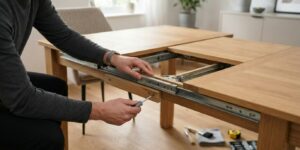
Is your dining table difficult to extend, stuck halfway, opening unevenly, or refusing to close properly? A problem with the extension mechanism does not always mean that you need to replace the entire table. In many cases, the problem can be caused by dust, debris, dry or dirty slides, loose hardware, misalignment, or normal wear.
This dining table extension mechanism repair guide explains how extendable table mechanisms work, how to identify common problems, and what you can do to clean, adjust, maintain, or repair the mechanism yourself.
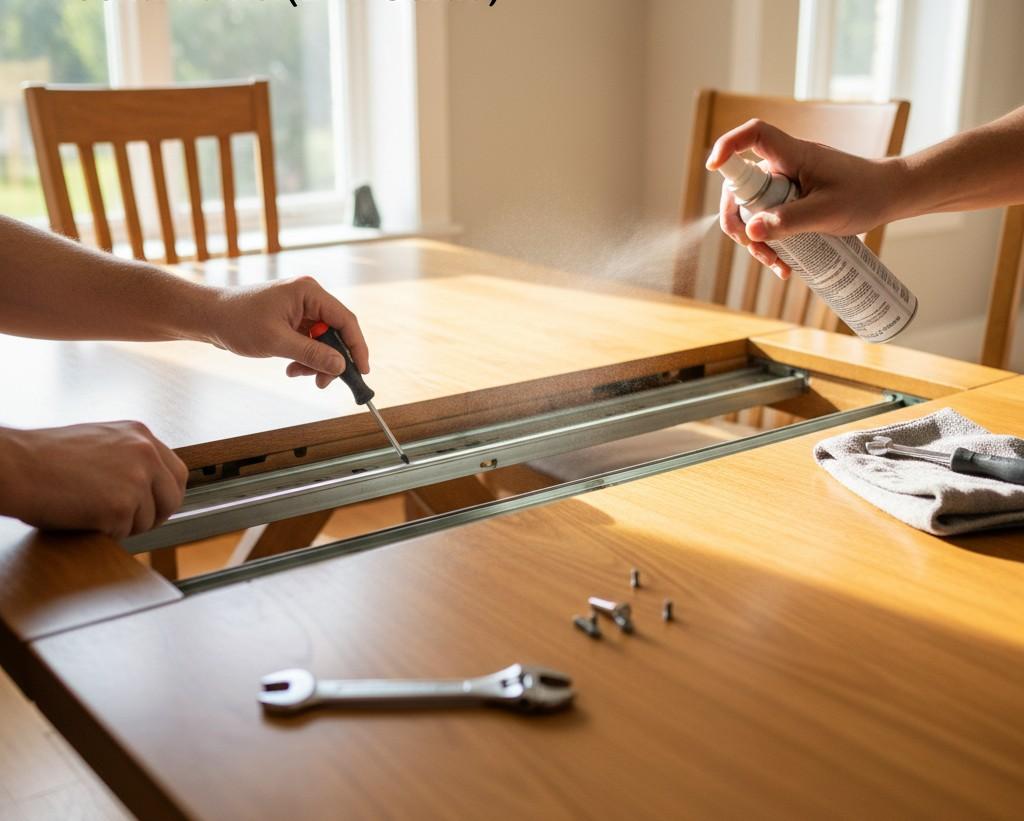
Whether your table uses wooden slide rails, metal runners, synchronized mechanisms, telescopic slides, or a butterfly leaf, the most important rule is simple: do not force a stuck table. Excessive force can damage the runners, gears, hinges, tabletop, or extension hardware.
Before reaching for replacement parts, take a few minutes to inspect the mechanism and determine what is actually preventing the table from moving normally.
Table of Contents
- Why Extendable Dining Tables Get Stuck or Uneven
- Types of Extendable Table Mechanisms
- How to Identify Your Dining Table Mechanism
- Tools and Materials You May Need
- Step-by-Step Dining Table Extension Mechanism Repair
- How to Fix a Dining Table That Won’t Open
- How to Fix an Uneven Dining Table Extension
- How to Fix a Dining Table Leaf That Doesn’t Fit
- How to Fix a Dining Table That Won’t Close
- How to Fix Creaking, Clicking, or Grinding Sounds
- How to Clean and Lubricate Table Extension Slides
- When to Replace the Extension Mechanism
- How to Maintain an Extendable Dining Table
- DIY Repair vs. Professional Furniture Repair
- Frequently Asked Questions
Why Extendable Dining Tables Get Stuck or Uneven
Extendable dining tables are designed to make additional seating available when you need it. They are especially useful for family gatherings, holidays, parties, and homes where space is limited.
However, the extension mechanism can develop problems over time. A table that once opened smoothly may eventually become difficult to pull apart, move unevenly, make unusual noises, or fail to close completely.
Some of the most common causes include:
- Dust and debris inside the sliding mechanism
- Dry or contaminated rails and runners
- Loose screws, bolts, or brackets
- Misaligned extension rails
- Warped or swollen wooden components
- Worn rollers or bearings
- Damaged metal rails
- Problems with synchronization components
- Loose or damaged hinges on folding leaves
- An extension leaf that is not positioned correctly
The good news is that not every problem requires professional furniture repair. Some issues can be addressed with careful cleaning, inspection, minor adjustment, and appropriate maintenance.
Types of Extendable Table Mechanisms
Before attempting a repair, it helps to understand what type of extension mechanism your table uses. Different mechanisms require different maintenance and repair approaches.
Wooden Slide Rails
Traditional dining tables often use wooden runners or slide rails. The two sections of the tabletop move apart along these rails to create space for the extension leaf.
Wooden slides can become difficult to operate when they accumulate dirt, become excessively dry, or swell because of changes in temperature and humidity.
Metal Table Extension Slides
Many modern extendable tables use metal runners or rails. These can provide smoother movement and may be combined with rollers, bearings, locks, or synchronization components.
Look for visible bends, loose mounting screws, corrosion, dirt, or damaged components when inspecting metal slides.
Ball-Bearing Extension Slides
Some mechanisms use ball bearings to provide smoother movement. If the mechanism becomes contaminated or a bearing becomes damaged, you may notice rough movement, clicking, grinding, or increased resistance.
Damaged bearing assemblies may need replacement rather than simple lubrication.
Telescopic Extension Mechanisms
Telescopic mechanisms use sections that slide into or alongside one another. They allow the tabletop to extend while keeping much of the hardware hidden underneath the table.
Misalignment in one section can prevent the entire mechanism from moving smoothly.
Butterfly Leaf Mechanisms
A butterfly leaf is a built-in extension leaf that folds in the middle and is stored underneath the tabletop when the table is closed.
These mechanisms rely on hinges, supports, and extension hardware. Common problems include loose hinges, damaged brackets, poor alignment, and difficulty folding or unfolding the leaf.

How to Identify Your Dining Table Mechanism
Before taking anything apart, look underneath the table while it is closed. If the table can be opened safely, extend it slightly and observe how the rails, supports, and leaf move.
Ask yourself:
- Are the runners made of wood or metal?
- Does the table use rollers or bearings?
- Does one side move when you pull the other?
- Does the extension leaf come completely out of the table?
- Does the leaf fold in the middle?
- Are there locks underneath the tabletop?
- Are there gears, cables, or connecting components between the two sides?
Knowing the mechanism type can help you avoid making an adjustment that is inappropriate for your particular table.
Tools and Materials You May Need
The exact tools depend on the design of your table, but common items include:
- Soft cloths
- Soft cleaning brushes
- Vacuum cleaner with a narrow attachment
- Screwdriver set
- Small adjustable wrench
- Ruler or measuring tape
- Carpenter’s square for checking alignment
- Fine sandpaper for appropriate wooden components
- Manufacturer-recommended lubricant, when applicable
- Wood glue for suitable minor wood repairs
You may not need every item on this list. Start with inspection and cleaning before purchasing replacement parts or specialized tools.
Step-by-Step Dining Table Extension Mechanism Repair
Step 1: Clear the Table
Remove dishes, decorations, table runners, and other objects from the tabletop. You want a clear working area because extendable tables can be heavy and awkward to move.
If the table is large or heavy, having another person assist you can make the inspection safer.
Step 2: Inspect the Mechanism
Carefully inspect the underside of the table. Look for dirt, dust, loose screws, damaged rails, corrosion, dried residue, bent metal, or anything that appears to be blocking movement.
If the table is stuck, do not immediately pull harder. Instead, determine where the movement appears to stop.
Step 3: Clean the Tracks and Runners
Use a soft brush or vacuum cleaner to remove loose dirt and debris from the runners and accessible moving components.
For wooden slides, avoid soaking the wood. A dry cloth or lightly dampened cloth is generally preferable for routine cleaning.
For metal components, remove accumulated dirt and residue carefully without damaging the finish or removing protective coatings.
Step 4: Check for Obstructions
Inspect the entire travel path of the mechanism. A loose screw, piece of wood, debris, or displaced component can prevent the tabletop from moving.
Also check whether a lock or latch underneath the table is still engaged.
Step 5: Check Alignment
If one side of the table moves farther than the other, inspect both sides of the extension mechanism.
Check whether the rails are parallel and whether the mounting hardware appears secure. A ruler or carpenter’s square can help you identify obvious alignment problems.
Do not randomly loosen or tighten structural bolts. Some hardware controls alignment or movement, and changing it without understanding its function can make the mechanism worse.
Step 6: Inspect Hinges and Extension Leaves
If your table uses a butterfly leaf or another folding extension, carefully inspect the hinges, brackets, supports, and leaf panels.
Look for loose screws, bent brackets, damaged hinges, or signs that the wood has warped.
How to Fix a Dining Table That Won’t Open
A dining table that will not extend is one of the most common extension mechanism problems.
Start with these checks:
- Make sure all locks or latches are released.
- Inspect the underside for visible obstructions.
- Clean dust and debris from the runners.
- Check for loose or protruding screws.
- Inspect the rails for visible damage or bends.
- Check whether both sides are aligned.
- Inspect rollers, bearings, or synchronization components if accessible.
If the table begins to move but becomes stuck at a particular point, pay close attention to that location. It may indicate a damaged section of rail, an obstruction, or a misaligned component.
Do not force the table open. Excessive pulling can damage the runners, gears, locks, tabletop joints, or extension hardware.
How to Fix an Uneven Dining Table Extension
If one side of your dining table opens farther or faster than the other, the extension mechanism may be misaligned or one of its components may be damaged.
Possible causes include:
- Loose mounting hardware
- Misaligned runners
- An obstruction on one side
- A damaged rail or roller
- A synchronization problem
- Uneven pressure being applied while opening the table
First, close the table and inspect both sides. Compare the position of the rails and mounting hardware.
If the table uses a synchronized mechanism, do not attempt to manually force one side into position without understanding how the system works. An incorrect adjustment can cause further misalignment.
For simple mounting adjustments, mark the original position of the hardware before making any changes. This gives you a reference point if you need to reverse the adjustment.
How to Fix a Dining Table Leaf That Doesn’t Fit
If the extension leaf no longer fits properly, the problem may not necessarily be the leaf itself.
Check the following:
- Is the tabletop fully extended?
- Are both sides of the table aligned?
- Are the support rails positioned correctly?
- Is there anything obstructing the leaf?
- Is the leaf installed in the correct orientation?
- Has the wood changed shape because of humidity?
- Are the tabletop sections sitting at the same height?
Wood naturally responds to changes in temperature and humidity. A leaf that once fit perfectly can develop a small amount of movement or warping over time.
Do not immediately sand a large amount of material from the leaf. First determine whether the actual problem is alignment or the extension mechanism.
If a wooden leaf genuinely requires minor adjustment, use fine sandpaper carefully and remove only a small amount of material at a time.
How to Fix a Dining Table That Won’t Close
A table that opens normally but will not close can have a different problem from a table that will not open.
First check whether the extension leaf has returned completely to its storage position.
For butterfly leaf tables, make sure the leaf has folded fully and is not catching on the tabletop, hinges, or support brackets.
Then inspect the extension mechanism for:
- Debris in the rails
- Loose screws
- Misaligned runners
- Bent metal components
- Damaged rollers
- Objects trapped underneath the tabletop
Move the table slowly while observing the mechanism. If it stops at exactly the same point every time, inspect that area carefully for an obstruction or damaged component.
How to Fix Creaking, Clicking, or Grinding Sounds
Unusual sounds can be an early warning that an extension mechanism needs cleaning, adjustment, or inspection.
A squeaking sound may be caused by dry surfaces or friction. Clicking or grinding can indicate debris, misalignment, worn rollers, damaged bearings, or a bent rail.
Start by cleaning the mechanism and checking for loose hardware.
If the mechanism requires lubrication, use a product that is appropriate for the specific material and mechanism. Follow the manufacturer’s maintenance instructions when available.
Apply lubricant sparingly. Excessive lubricant can collect dust and debris and may eventually make the mechanism dirtier rather than cleaner.
If grinding continues after cleaning and appropriate maintenance, inspect the rails, rollers, and bearings for physical damage.
How to Clean and Lubricate Table Extension Slides
Cleaning should generally come before lubrication.
1. Remove dirt and debris
Use a soft brush, cloth, or vacuum cleaner to remove loose debris from accessible parts of the mechanism.
2. Inspect the moving components
Look for damaged rails, worn rollers, loose screws, corrosion, or anything that could interfere with movement.
3. Choose the right lubricant
Do not assume that every dining table mechanism should use the same lubricant. The appropriate product depends on the mechanism, materials, and manufacturer’s recommendations.
Some mechanisms may be suitable for a dry lubricant, silicone-based product, wax, or another product specifically intended for the hardware. Always check manufacturer instructions when available.
4. Apply only a small amount
More lubricant does not necessarily mean smoother operation. Apply only what is needed to the appropriate moving surfaces.
5. Test the table
Open and close the table slowly several times. Listen for unusual sounds and check whether the movement has improved.
When to Replace the Extension Mechanism
Cleaning and adjustment will not fix every problem. Some extension mechanisms are simply too damaged or worn to repair economically.
Replacement may be worth considering if:
- A metal rail is severely bent.
- A roller or bearing is broken.
- Important gear teeth are damaged.
- A major bracket has cracked.
- The mechanism has excessive movement or play.
- The same component repeatedly fails.
- A compatible replacement part is available.
Before purchasing replacement hardware, measure the existing mechanism carefully.
Depending on the design, you may need to know the:
- Overall length
- Closed length
- Extension length
- Rail width
- Mounting-hole spacing
- Mounting position
- Available clearance underneath the tabletop
Whenever possible, compare the replacement part with the original before purchasing it.
How to Maintain an Extendable Dining Table
Regular maintenance can help prevent many common extension mechanism problems.
- Keep the mechanism clean: Remove dust and debris from runners and accessible moving parts.
- Inspect the hardware: Check periodically for loose screws, bolts, brackets, and supports.
- Operate the table gently: Extend and retract the tabletop slowly instead of pulling suddenly.
- Store removable leaves properly: Keep them in a suitable dry environment and avoid unnecessary exposure to moisture.
- Watch for unusual sounds: Address grinding, clicking, or excessive squeaking before the problem becomes worse.
- Check alignment: If the table starts opening unevenly, investigate the mechanism before continuing to use excessive force.
- Follow manufacturer instructions: If your table came with specific maintenance instructions, use those recommendations as the primary reference.
DIY Repair vs. Professional Furniture Repair
Many minor extendable table problems can be addressed at home, particularly when the cause is dirt, a simple obstruction, or loose hardware.
However, professional furniture repair may be the better choice when you encounter:
- Severely bent metal components
- Broken gears
- Damaged synchronization systems
- Major structural damage
- Complex internal mechanisms
- Antique or high-value furniture
- A table that remains unstable after adjustment
If you are unsure which component controls the table’s movement, avoid taking the entire mechanism apart. Taking photographs before making adjustments can also help you restore the original configuration if necessary.

Quick Troubleshooting Guide
| Problem | Possible Cause | First Thing to Check |
|---|---|---|
| Table will not open | Lock, dirt, dry slide, obstruction, or damaged rail | Release locks and inspect the runners |
| Table opens unevenly | Misalignment or synchronization problem | Compare both sides of the mechanism |
| Leaf does not fit | Alignment, warped wood, or obstruction | Make sure the tabletop is fully extended |
| Table will not close | Leaf, rail, lock, or obstruction problem | Inspect the leaf storage area and rails |
| Table squeaks | Friction or dry moving surfaces | Clean and inspect the mechanism |
| Table grinds or clicks | Debris, damaged roller, bearing, or rail | Inspect the moving components |
| Table feels loose | Loose hardware or worn components | Inspect screws, bolts, and brackets |
| One side moves but the other does not | Synchronization or rail problem | Inspect the connecting mechanism |
Important DIY Safety Tips
Extendable dining tables contain moving components that can pinch fingers or move unexpectedly. Some tabletops and extension leaves can also be surprisingly heavy.
- Keep your fingers away from moving rails and hinges.
- Do not place your hands between tabletop sections while operating the mechanism.
- Use assistance when handling heavy tabletop sections or leaves.
- Use appropriate tools rather than forcing hardware with unsuitable tools.
- Do not force a mechanism that is completely stuck.
- Do not remove structural hardware unless you understand its purpose.
- Support heavy components when working underneath the table.
Frequently Asked Questions
Why won’t my dining table extension open?
A dining table may not open because the locking mechanism is still engaged, the extension slides are dirty or damaged, something is obstructing the rails, or the mechanism has become misaligned. Inspect the underside before applying force.
How do I fix a stuck dining table slide?
Start by cleaning the slide and removing dust or debris. Inspect it for loose screws, bent rails, or other obstructions. If the mechanism is designed to be lubricated, use an appropriate lubricant sparingly according to the manufacturer’s recommendations.
Why does my extendable dining table open unevenly?
Uneven movement can result from misaligned rails, loose mounting hardware, an obstruction, a damaged roller, or a synchronization problem. Inspect both sides of the mechanism before making adjustments.
Why won’t my dining table close?
Check that the extension leaf has returned completely to its storage position and that nothing is blocking the rails. Also inspect the mechanism for loose hardware, bent components, or alignment problems.
Can I lubricate my dining table extension mechanism?
Some extension mechanisms benefit from lubrication, but the appropriate lubricant depends on the design and materials. Check the manufacturer’s instructions when available and avoid applying excessive lubricant.
Can a dining table extension mechanism be replaced?
Many dining table extension mechanisms can be replaced if compatible hardware is available. Measure the original mechanism carefully, including its length, mounting-hole spacing, extension range, and clearance, before purchasing a replacement.
How do I know if my dining table extension mechanism is broken?
Visible cracks, severely bent rails, broken rollers, damaged bearings, missing hardware, or persistent instability can indicate a damaged mechanism. If cleaning and basic adjustment do not solve the problem, replacement or professional repair may be necessary.
Should I force a stuck dining table open?
No. Forcing a stuck table can damage the extension rails, gears, locks, hinges, or tabletop. Instead, identify where the mechanism is becoming restricted and inspect that area first.
Keep Your Dining Table Working Smoothly
Dining table extension mechanism repair does not always require replacing the entire table. Many common problems can be traced to dirt, debris, loose hardware, misalignment, worn components, or normal changes in wooden parts caused by temperature and humidity.
The best approach is to start with the simplest possible solution: inspect the mechanism, clean the rails, check for obstructions, verify alignment, and look for visible damage.
Most importantly, do not force a stuck extension mechanism. A little patience during troubleshooting can prevent a small problem from becoming an expensive repair.
With proper cleaning, careful operation, and regular maintenance, an extendable dining table can continue to provide smooth and reliable service for many years.